

About 3rd Party Reference Framework of Cybersecurity Industry
THE COI


01 About Tertiary Sector
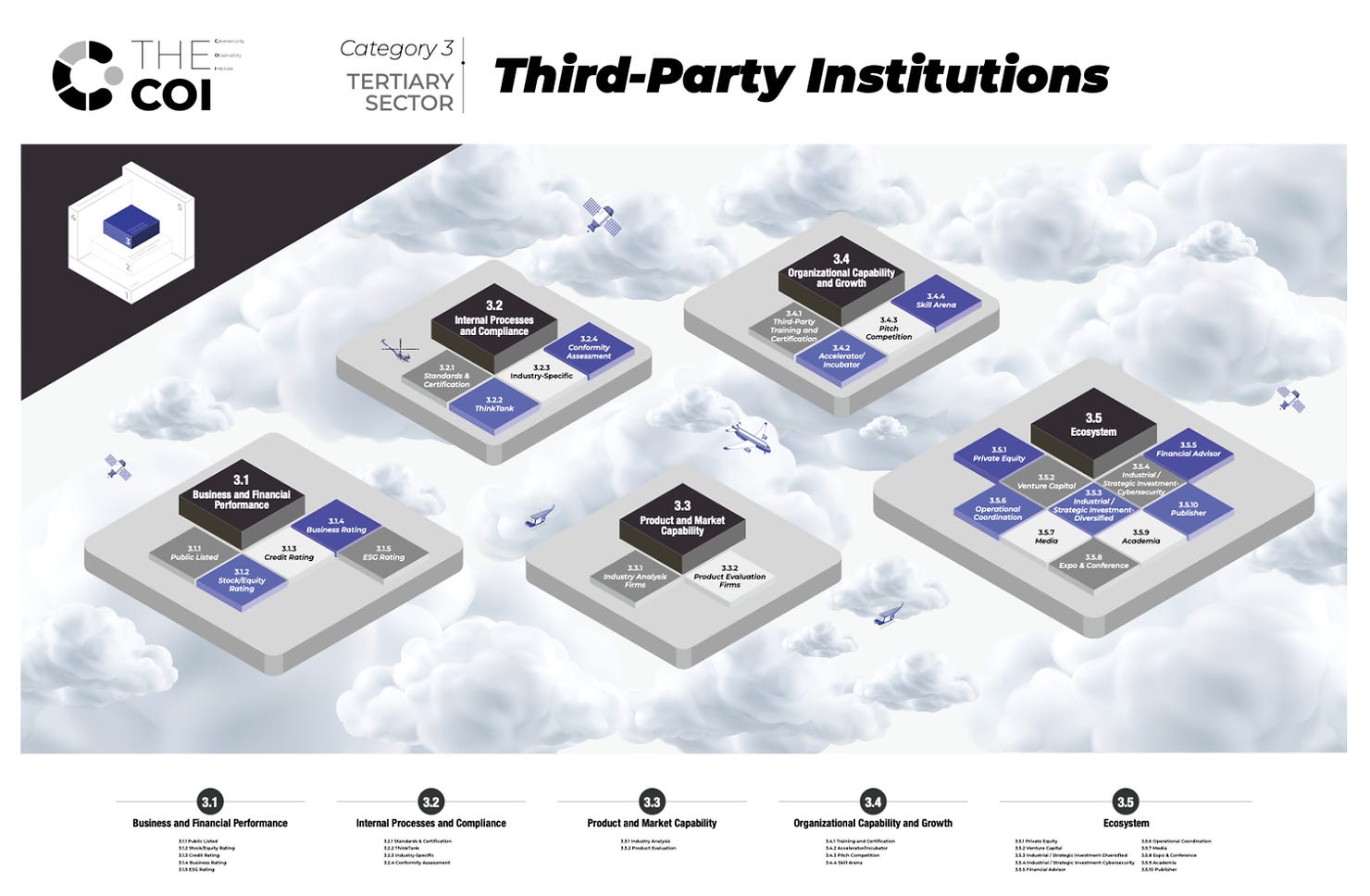
Category 3: Third-Party Institutions (Tertiary Sector)
“Third-party institutions,” as defined in this report, are independent organizations or systems that do not directly provide products or services, but through institutionalized mechanisms actively articulate knowledge, judgments, and opinions, producing outputs that are recognized, referenced, and materially influence vendor assessment, trust formation, and business decisions.
02 The Significance of Third-Party Institutions
Symbols, Trust, and Business Choice
In the global cybersecurity market, no single arbiter exists. Instead, numerous third-party institutions express judgment through their respective symbolic languages. These signals circulate within the market—repeatedly invoked and mutually referenced—and gradually converge into a distributed form of expert trust, ultimately crystallizing into concrete business choices and decisions.
Across the market, multiple categories of third-party institutions with transnational influence together form a reference system. This system does not operate through coercion, yet it exerts an implicit normative force. Business choices become the medium through which symbols transmit consensus; consensus, in turn, settles into trust.
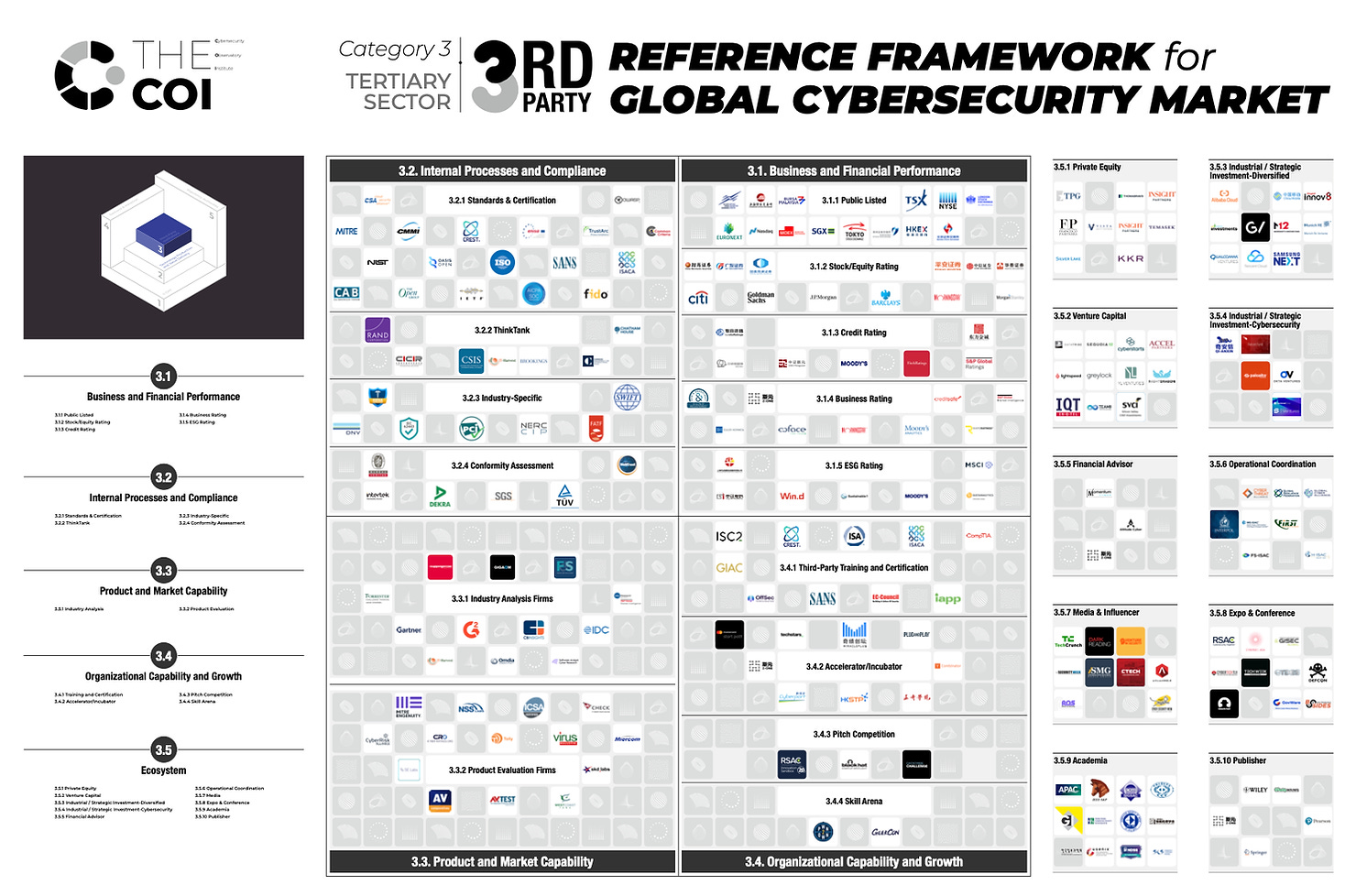
Principles for Selecting Global Third-Party Institutions
Institutions included in this framework are selected based on the following criteria:
Independent third-party position within the cybersecurity value chain, without direct involvement in product development, delivery, or end-user roles.
Recognizable judgment outputs, including standards, certifications, ratings, research, or publicly articulated methodologies, that are understandable and referable by the market.
Market-relevant influence, where—except for statutory regulatory bodies in specific jurisdictions—conclusions are non-mandatory but provide meaningful reference for market entry, compliance perception, trust building, and partnership decisions.
Cross-regional applicability, with sustained relevance across multiple countries or international business contexts.
03 Notes
Reference Framework Usage Notes
Representative, not exhaustive: Institutions are selected for representativeness only and do not constitute a comprehensive list.
Multiple roles: Some institutions perform multiple functions and may appear in more than one category, reflecting practical influence rather than a single classification.
Time- and context-bound: This framework reflects institutional influence at the time of research. Roles and market impact may evolve with policy, market, or strategic changes.
Information sources and neutrality: All content is based on publicly available information. Inclusion does not imply endorsement of past outputs, nor recommendation of future applicability.
Disclaimer: This framework represents COI’s professional judgment at the time of publication. Users should conduct independent evaluation based on their own business, regulatory, and compliance requirements.
04 About THE COI
THE COI (Cybersecurity Observatory Institute) is an independent, non-profit research institute dedicated to the sustained observation and systematic epistemic study of the global cybersecurity ecosystem as a structured, multi-layered industry.
Established for academic and public-interest purposes, THE COI does not engage in vulnerability trading, technology production, commercial services, or compliance enforcement. Instead, it operates as a neutral observatory—examining how cybersecurity capabilities are generated, commercialized, institutionalized, and governed across different sectors and jurisdictions.
By systematically mapping actors, roles, and interactions across the sectors of cybersecurity, THE COI develops analytical frameworks, ecosystem models, and research outputs intended to support informed decision-making by users, institutions, and policymakers.
THE COI is independent by structure.
Its role is not to participate, but to observe, study, and clarify the complexities of an evolving global cybersecurity landscape.
Contact THE COI
info@the-coi.org
www.linkedin.com/company/thecoi/
